

























































































































































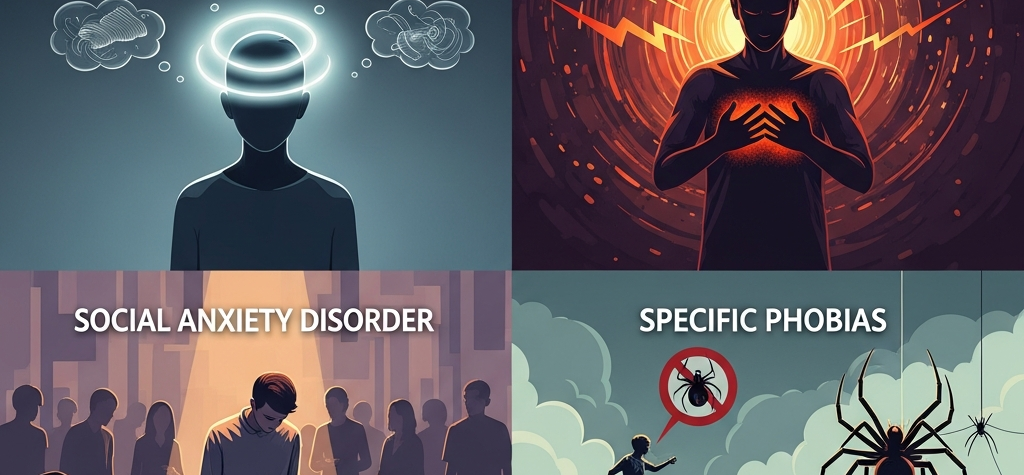
4 Main Types of Anxiety Disorders: Symptoms, Causes, and Treatment
Author: RVLNSV PRASAD
Updated On: September 2026
About Us
Author Bio
Editorial Policy
Contact Us
Quick Answer: What Are the 4 Main Types of Anxiety Disorders?
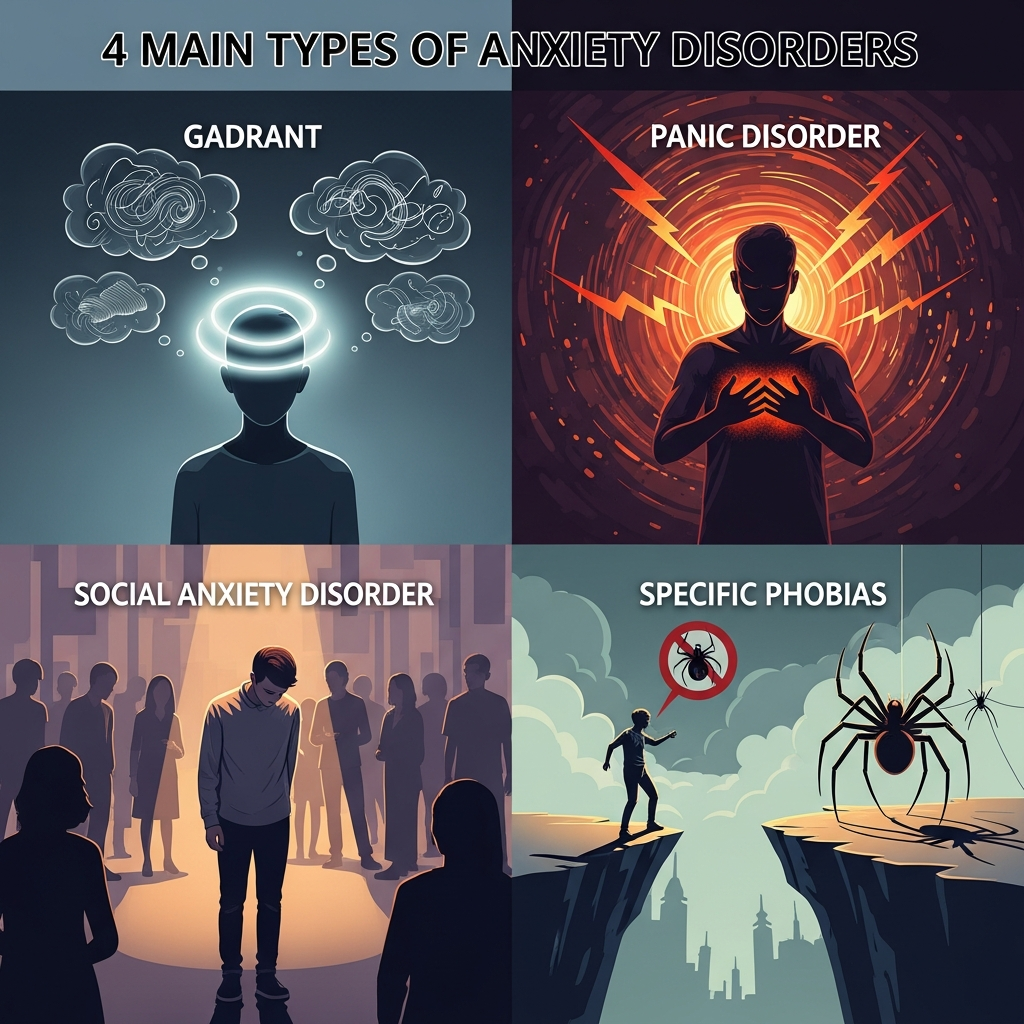
The four anxiety disorders covered in this article are Generalized Anxiety Disorder (GAD), Panic Disorder, Social Anxiety Disorder, and Specific Phobia. Each has a different pattern of fear, worry, or avoidance. Anxiety disorders are treatable, and treatment may include psychotherapy, medication, or both, depending on the condition and individual needs. These are not the only anxiety disorders; other conditions include agoraphobia and separation anxiety disorder.
Key Takeaways
- Generalized Anxiety Disorder (GAD) involves excessive worry about several areas of life.
- Panic disorder involves recurrent unexpected panic attacks and concern about having additional attacks.
- Social Anxiety Disorder involves significant fear of social or performance situations and possible judgment.
- Specific phobia involves intense fear of a particular object or situation.
- These are four types discussed in this article, not the complete list of anxiety disorders.
- Anxiety disorders can affect thoughts, emotions, physical sensations, behavior, sleep, work, and relationships.
- Evidence-based treatment may include psychotherapy, medication, or both.
- If anxiety is interfering with everyday life, speaking with a qualified healthcare or mental health professional can help.
Medical Disclaimer
This article is for educational purposes only. It does not diagnose or treat anxiety disorders. If anxiety is interfering with your daily life, relationships, work, school, sleep, or safety, speak with a qualified healthcare or mental health professional.
Introduction
Anxiety is a normal human emotion. Almost everyone feels anxious at times, especially before an important event, during a stressful situation, or when facing uncertainty.
But an anxiety disorder is different from occasional worry.
When fear or worry becomes excessive, difficult to control, persistent, or disruptive to everyday life, it may be part of an anxiety disorder. The National Institute of Mental Health (NIMH) explains that anxiety disorders involve more than temporary worry or fear and can interfere with daily activities. NIMH: Anxiety Disorders
The World Health Organization (WHO) reports that anxiety disorders are the world’s most common mental disorders, affecting an estimated 359 million people in 2021. Effective treatments are available, yet many people who could benefit from treatment do not receive it. WHO: Anxiety Disorders
There are several different anxiety disorders. This article focuses on 4 main types of anxiety disorders that many readers are looking for information about:
- Generalized Anxiety Disorder (GAD)
- Panic Disorder
- Social Anxiety Disorder
- Specific Phobia
These four categories are not the complete list of anxiety disorders. Other anxiety-related diagnoses include conditions such as agoraphobia and separation anxiety disorder. The American Psychiatric Association’s description of anxiety disorders and the NIMH classification both recognize multiple anxiety disorders. American Psychiatric Association: What Are Anxiety Disorders?
Understanding the differences between these conditions can help you recognize patterns and know when professional support may be appropriate.
What Is Anxiety?
Anxiety is your body’s natural response to perceived danger, uncertainty, or stress.
It can affect your thoughts, emotions, body, and behavior.
You might notice:
- Excessive worrying
- Feeling tense or restless
- Difficulty concentrating
- Rapid heartbeat
- Sweating
- Trembling or shaking
- Shortness of breath
- Muscle tension
- Stomach discomfort
- Difficulty sleeping
- Avoiding situations that cause fear
Occasional anxiety does not necessarily mean you have an anxiety disorder.
The important difference is the severity, persistence, and impact on daily life.
The American Psychiatric Association notes that anxiety-disorder symptoms are generally persistent or disproportionate to the situation and interfere with normal functioning. APA: What Are Anxiety Disorders?
What Are the 4 Main Types of Anxiety Disorders?
The four types discussed in this guide are
| Type | Main feature | Common examples |
|---|---|---|
| Generalized Anxiety Disorder | Excessive worry about several areas of life | Health, money, family, work |
| Panic Disorder | Recurrent unexpected panic attacks | Sudden intense fear and physical symptoms |
| Social Anxiety Disorder | Strong fear of being judged or embarrassed | Speaking, meeting people, performing |
| Specific Phobia | Intense fear of a particular object or situation | Heights, flying, spiders, injections |
Each condition has its own pattern. A person can also experience more than one anxiety disorder.
WHO notes that people may experience different forms of anxiety and that symptoms can include excessive fear or worry, physical tension, avoidance, sleep problems, sweating, trembling, palpitations, and difficulty concentrating. WHO: Anxiety disorders
Let’s look at each type more closely.
1. Generalized Anxiety Disorder (GAD)
Generalized Anxiety Disorder, or GAD, involves excessive anxiety and worry about several areas of everyday life.
A person with GAD may worry about health, family, finances, work, school, responsibilities, or ordinary daily events.
The problem is not simply having concerns.
The worry can become difficult to control and may occur more days than not for an extended period.
According to NIMH, generalized anxiety disorder is characterized by excessive anxiety and worry about a variety of events or activities occurring more days than not for at least six months. NIMH: Generalized Anxiety Disorder
Common Symptoms of GAD
Someone with GAD may experience:
- Persistent or excessive worry
- Difficulty controlling worry
- Restlessness or feeling on edge
- Fatigue
- Difficulty concentrating
- Irritability
- Muscle tension
- Sleep problems
The symptoms can affect work, school, relationships, and everyday responsibilities.
Example of Generalized Anxiety Disorder
Imagine someone who spends much of the day worrying about several different problems.
They may worry that something will go wrong at work.
Then they may become concerned about their family’s health.
Later, they may worry about money or future responsibilities.
Even after receiving reassurance, the worrying may return.
This pattern is different from simply being concerned about an important problem.
What Can Help With GAD?
Treatment can include psychotherapy, medication, or a combination of approaches depending on the person’s needs.
Cognitive behavioral therapy (CBT) is one psychological approach used for anxiety disorders. It can help people recognize unhelpful patterns of thinking and develop healthier ways of responding to anxiety.
NIMH provides additional information about GAD symptoms, treatment, and finding help. Learn more about GAD from NIMH.
2. Panic Disorder
Panic disorder involves recurrent unexpected panic attacks and may also involve ongoing concern about having additional attacks or changes in behavior related to them.
A panic attack can be extremely frightening.
It may happen suddenly and can produce strong physical and emotional symptoms.
What Does a Panic Attack Feel Like?
Possible symptoms include:
- Rapid heartbeat
- Sweating
- Trembling
- Shortness of breath
- Chest discomfort
- Dizziness
- Chills or hot sensations
- Nausea
- Feeling detached from yourself
- Fear of losing control
- Fear of dying
Because these symptoms can resemble symptoms of other medical conditions, a person experiencing severe or unfamiliar symptoms should not automatically assume they are caused by anxiety.
If someone has new, severe, or concerning chest pain, breathing difficulty, fainting, or other potentially serious symptoms, urgent medical evaluation may be appropriate.
Why Panic Attacks Can Become a Cycle
After experiencing a frightening panic attack, a person may begin worrying about having another one.
They may start monitoring their heartbeat or breathing.
They may avoid places where they previously experienced panic.
Over time, fear of another attack can affect daily activities.
NIMH describes panic disorder as involving repeated panic attacks and ongoing concern or behavioral changes related to the attacks. NIMH: Panic Disorder
Can Panic Disorder Be Treated?
Yes.
Psychotherapy, including CBT, is commonly used to treat panic disorder. Treatment can help people understand the relationship between thoughts, physical sensations, fear, and avoidance.
Medication may also be considered by a healthcare professional depending on the individual situation.
MedlinePlus explains that psychotherapy, medicines, or both may be used to treat anxiety disorders. MedlinePlus: Anxiety
3. Social Anxiety Disorder
Social anxiety disorder involves an intense and persistent fear of social or performance situations in which a person may feel watched, evaluated, embarrassed, rejected, or judged.
It is more than ordinary shyness.
Someone with social anxiety may understand that their fear is excessive but still find it extremely difficult to control.
NIMH describes social anxiety disorder as persistent fear in situations involving possible scrutiny or judgment by others. NIMH: Social Anxiety Disorder
Common Situations That Can Trigger Social Anxiety
Examples include:
- Speaking in front of a group
- Answering questions in class
- Attending meetings
- Meeting unfamiliar people
- Going on a date
- Job interviews
- Eating or drinking around others
- Asking for help
- Making telephone calls
- Performing in front of others
Some people may begin avoiding situations that cause anxiety.
That avoidance can provide temporary relief but may also make it harder to participate in everyday activities.
Social Anxiety Is More Than Being Shy
Everyone can feel uncomfortable in unfamiliar social situations.
Social anxiety disorder becomes more concerning when fear is persistent, difficult to control, and significantly interferes with daily functioning.
For example, a person may avoid an important job interview because they are terrified of being judged.
Another person may avoid speaking in class despite knowing the answer.
Someone else may avoid social events because they are afraid of embarrassing themselves.
These patterns can have a significant effect on education, employment, relationships, and quality of life.
Treatment for Social Anxiety Disorder
Treatment may include psychotherapy, medication, or both.
CBT and exposure-based approaches can help people gradually change how they respond to feared social situations.
Treatment should be individualized rather than based on trying to “force” confidence.
NIMH provides detailed information about social anxiety symptoms and treatment options. Social Anxiety Disorder: What You Need to Know
4. Specific Phobia
A specific phobia is an intense fear of a particular object or situation.
The fear may be much stronger than the actual danger posed by the object or situation.
Common examples include fear of:
- Heights
- Flying
- Spiders
- Dogs
- Injections
- Blood
- Certain animals
- Enclosed spaces
- Specific situations
The person may experience intense anxiety when encountering the feared situation.
They may also avoid it whenever possible.
NIMH explains that specific phobias involve intense fear or anxiety about particular objects or situations and can lead to avoidance. NIMH: Phobias and Phobia-Related Disorders
Example of a Specific Phobia
Consider someone who has an intense fear of flying.
They may experience significant anxiety weeks before a flight.
They might avoid air travel completely, even when flying would be important for work or family.
Another person may have a strong fear of injections and avoid necessary medical care because of that fear.
The important issue is not simply disliking something.
It is the intensity of the fear and the extent to which it affects the person’s life.
How Are Specific Phobias Treated?
Psychotherapy is an important treatment approach for phobias.
Exposure therapy, a form of CBT, can help people gradually face feared situations in a structured and controlled way.
This should be done appropriately and, when needed, with professional guidance.
NIMH identifies CBT and exposure-based approaches as established treatments for phobia-related disorders. NIMH phobia treatment information
4 Main Types of Anxiety Disorders Compared
Understanding the differences can make these conditions easier to distinguish.
| Anxiety disorder | Main fear or concern | Typical pattern |
|---|---|---|
| Generalized Anxiety Disorder | Excessive worry about several areas of life | Persistent worry |
| Panic Disorder | Unexpected panic attacks and concern about additional attacks | Sudden episodes of intense fear |
| Social Anxiety Disorder | Fear of scrutiny, embarrassment, or judgment | Social or performance situations |
| Specific Phobia | Fear of a particular object or situation | Trigger-specific fear and avoidance |
These descriptions are simplified for educational purposes. A qualified professional uses a person’s full history, symptoms, duration, and level of impairment when making a diagnosis.
Are These the Only Types of Anxiety Disorders?
No.
This is an important distinction.
The phrase “4 main types of anxiety disorders” is useful for understanding four commonly discussed conditions, but it should not be interpreted as meaning that there are only four anxiety disorders.
WHO lists several anxiety disorders, including
- Generalized anxiety disorder
- Panic disorder
- Social anxiety disorder
- Agoraphobia
- Separation anxiety disorder
- Specific phobias
- Selective mutism
NIMH also describes several anxiety and phobia-related disorders.
The exact classification depends on the diagnostic system and context.
That is why it is better to say that this article focuses on four major types rather than claiming that these are the only four anxiety disorders. WHO: Anxiety disorders
Common Anxiety Disorder Symptoms
Although each anxiety disorder has its own features, symptoms can affect several areas.
Emotional Symptoms
A person may experience:
- Excessive fear
- Persistent worry
- Feeling on edge
- Irritability
- A sense of impending danger
- Difficulty relaxing
Physical Symptoms
Anxiety can also produce physical sensations such as
- Rapid heartbeat
- Sweating
- Trembling
- Muscle tension
- Dizziness
- Shortness of breath
- Stomach discomfort
- Sleep problems
Behavioral Symptoms
Behavior can change as anxiety becomes more difficult to manage.
Someone may:
- Avoid feared situations
- Seek repeated reassurance
- Stop participating in activities
- Avoid social situations
- Have difficulty completing everyday tasks
The American Psychiatric Association identifies emotional, physical, and behavioral symptoms among the features associated with anxiety disorders. APA: Anxiety Disorders
What Causes Anxiety Disorders?
There is usually no single cause.
Anxiety disorders can develop through a complex interaction of biological, psychological, and environmental factors.
Possible contributing factors include:
- Family history
- Genetics
- Brain biology
- Stress
- Traumatic experiences
- Difficult life circumstances
- Certain physical health conditions
- Some medications or substances
MedlinePlus notes that genetics, brain biology and chemistry, stress, and environmental factors may all play a role. MedlinePlus: Anxiety
WHO similarly describes anxiety disorders as resulting from complex interactions among social, psychological, and biological factors.
This means that blaming yourself for developing an anxiety disorder is not helpful.
Anxiety disorders are health conditions with multiple possible contributing factors.
Who Is More Likely to Develop an Anxiety Disorder?
Anyone can develop an anxiety disorder.
Risk can be influenced by a person’s genetics, environment, life experiences, physical health, and other factors.
A family history of anxiety or other mental health conditions may increase risk.
Traumatic or highly stressful experiences can also contribute.
Some physical health conditions may produce symptoms that resemble anxiety, which is one reason professional assessment can be important.
MedlinePlus lists family history, traumatic experiences, certain personality traits, and some physical health conditions among factors associated with anxiety disorders. MedlinePlus anxiety information
How Are Anxiety Disorders Diagnosed?
There is no simple blood test that tells you which anxiety disorder you have.
A healthcare provider generally considers:
- Your symptoms
- How long they have been occurring
- What situations trigger them
- How much they interfere with daily life
- Your medical history
- Your mental health history
- Medications or substances you use
- Other possible medical explanations
A physical examination or laboratory testing may sometimes be appropriate when a healthcare professional needs to rule out another medical condition.
MedlinePlus explains that healthcare providers may review symptoms and medical history, perform a physical examination or tests when appropriate, and conduct or arrange a psychological evaluation. MedlinePlus: Anxiety
Why Self-Diagnosis Can Be Misleading
Searching online for symptoms can help you learn about anxiety.
However, several medical conditions can produce symptoms such as rapid heartbeat, dizziness, sweating, or shortness of breath.
Likewise, experiencing occasional worry does not automatically mean you have an anxiety disorder.
A qualified professional can consider the complete pattern rather than one isolated symptom.
How Are Anxiety Disorders Treated?
Anxiety disorders are treatable.
Treatment depends on the specific condition, severity, personal circumstances, preferences, and other health considerations.
Common approaches include psychotherapy, medication, or a combination of both.
Cognitive Behavioral Therapy
Cognitive behavioral therapy, commonly called CBT, is an evidence-based psychological treatment used for several anxiety disorders.
It can help people identify unhelpful thought and behavior patterns and develop healthier responses to anxiety.
Some forms of CBT include exposure-based approaches, which can help people gradually face situations they have been avoiding.
WHO identifies psychological interventions based on CBT principles, including exposure approaches, among effective treatments for anxiety disorders. WHO: Anxiety disorders
Medication
Healthcare professionals may prescribe medication for some people with anxiety disorders.
Depending on the disorder and individual circumstances, medicines can include certain antidepressants or other medications.
Medication choices should be discussed with a qualified healthcare professional.
Do not start, stop, or change a prescription medication because of information in an online article.
NIMH provides information about medications commonly used for anxiety disorders and explains that treatment decisions should be made with a healthcare provider. NIMH: Mental Health Medications
Lifestyle and Self-Care
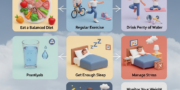
Healthy daily habits can support overall well-being and may complement professional treatment.
Helpful habits can include:
- Regular physical activity
- Consistent sleep
- Regular meals
- Relaxation techniques
- Mindfulness practices
- Staying connected with supportive people
- Limiting alcohol if it worsens anxiety
These habits should not be presented as a replacement for professional treatment when an anxiety disorder is significantly affecting someone’s life.
WHO includes regular exercise, healthy eating and sleeping routines, relaxation skills, mindfulness, and reducing alcohol or illicit drug use among self-care measures that can support people with anxiety. WHO self-care guidance
Can Anxiety Disorders Go Away?
Some people experience periods when anxiety symptoms become much less severe, while others may need ongoing treatment or support.
The course varies from person to person.
The good news is that effective treatments are available, and many people can learn to manage their symptoms and participate more fully in everyday life.
Recovery does not necessarily mean never feeling anxious again.
A more realistic goal may be learning to respond to anxiety differently so that it no longer controls important areas of life.
When Should You Seek Help for Anxiety?
Consider speaking with a healthcare or mental health professional if anxiety:
- Interferes with work or school
- Disrupts sleep
- Affects relationships
- Causes you to avoid important activities
- Is difficult to control
- Causes significant distress
- Keeps returning or becoming more severe
- Leads you to rely on alcohol or other substances to cope
You do not have to wait until anxiety becomes overwhelming before seeking help.
Early support can make it easier to understand what is happening and identify appropriate treatment.
If you are experiencing thoughts of suicide, self-harm, or immediate danger, seek urgent local emergency or crisis support rather than relying on an online article.
Anxiety vs. Normal Worry: What’s the Difference?
Normal worry is part of everyday life.
For example, you may feel nervous before an examination, job interview, medical appointment, or important conversation.
That temporary anxiety may decrease when the situation passes.
An anxiety disorder is different because symptoms can be excessive, persistent, difficult to control, and disruptive to daily functioning.
| Normal anxiety | Anxiety disorder |
|---|---|
| Often linked to a specific situation | May persist or occur across situations |
| Usually decreases when the situation ends | Can continue or become difficult to control |
| Usually manageable | May feel overwhelming |
| Limited effect on daily life | Can interfere with work, school, relationships, or activities |
| Often temporary | May persist for an extended period |
This comparison is simplified and cannot replace a professional assessment.
Can Exercise and Healthy Habits Help Anxiety?
Regular physical activity can support mental and physical health.
For some people, walking, strength training, yoga, or another enjoyable form of movement can be a useful part of an overall wellness routine.
However, exercise should not be presented as a cure for an anxiety disorder.
Similarly, getting enough sleep, eating regular balanced meals, practicing relaxation techniques, and maintaining social connections may support well-being without replacing evidence-based treatment.
WHO identifies exercise, regular sleep and eating patterns, relaxation skills, and mindfulness among measures that may help people manage anxiety symptoms. WHO anxiety guidance
What I Learned From Looking at Anxiety More Closely
Anxiety is often misunderstood.
People sometimes assume that someone with anxiety simply needs to “stop worrying” or “be more confident.”
It is not always that simple.
The same situation can feel manageable to one person and overwhelming to another.
What matters is understanding the pattern rather than judging the person.
Learning about the different types of anxiety disorders can make it easier to recognize when fear or worry has moved beyond ordinary stress.
It can also encourage people to seek appropriate support instead of blaming themselves.
This article is intended to provide education, not to label or diagnose anyone.
Frequently Asked Questions
1. What are the 4 main types of anxiety disorders?
The four types discussed in this article are generalized anxiety disorder, panic disorder, social anxiety disorder, and specific phobia.
They have different patterns. GAD involves excessive worry about several areas of life, panic disorder involves recurrent panic attacks, social anxiety disorder involves significant fear of social or performance situations, and specific phobia involves intense fear of a particular object or situation.
These are not the only anxiety disorders.
2. What is the most common type of anxiety disorder?
There is no single answer that applies to every country and population.
Generalized anxiety disorder is one of the major anxiety disorders and involves persistent excessive worry about multiple areas of life.
Prevalence differs depending on the population studied and the diagnostic criteria used.
3. What are the common symptoms of anxiety disorders?
Symptoms can include excessive worry, fear, restlessness, difficulty concentrating, muscle tension, rapid heartbeat, sweating, trembling, dizziness, shortness of breath, sleep problems, and avoidance.
Not everyone experiences all of these symptoms.
4. Can anxiety disorders be treated?
Yes.
Effective treatments are available. Depending on the condition and individual circumstances, treatment may include psychotherapy, medication, or both.
CBT is one commonly used psychological treatment for anxiety disorders.
5. Is a panic attack the same as panic disorder?
No.
A person can experience a panic attack without necessarily having panic disorder.
Panic disorder involves recurrent unexpected panic attacks together with ongoing concern or behavioral changes related to the attacks.
A healthcare professional can determine whether the overall pattern meets diagnostic criteria.
6. Is social anxiety the same as being shy?
No.
Shyness is common and does not necessarily cause significant impairment.
Social anxiety disorder involves persistent fear or anxiety related to social or performance situations and can interfere substantially with everyday life.
7. What is a specific phobia?
A specific phobia is an intense fear of a particular object or situation.
Examples include fear of flying, heights, spiders, injections, or certain animals.
The fear can lead to significant distress or avoidance.
8. What causes anxiety disorders?
There is usually no single cause.
Genetics, brain biology, stressful experiences, trauma, environmental factors, physical health conditions, and other influences can contribute.
Different people may develop anxiety disorders for different reasons.
9. Can lifestyle changes cure anxiety disorders?
Healthy habits can support overall well-being and may complement treatment, but they should not be considered a universal cure.
If anxiety is significantly affecting your life, professional assessment and evidence-based treatment may be appropriate.
10. When should I see a doctor or mental health professional for anxiety?
Consider seeking professional help when anxiety is persistent, difficult to control, or interfering with sleep, work, education, relationships, or normal activities.
You can discuss your symptoms with a primary healthcare provider, psychologist, psychiatrist, therapist, or another appropriately qualified professional.
Trusted Resources for Anxiety Disorders
For additional reliable information, consider these authoritative sources:
- National Institute of Mental Health — Anxiety Disorders
- National Institute of Mental Health — Generalized Anxiety Disorder
- National Institute of Mental Health — Social Anxiety Disorder
- NIMH — Phobias and Phobia-Related Disorders
- World Health Organization — Anxiety Disorders
- MedlinePlus — Anxiety
- American Psychiatric Association — What Are Anxiety Disorders?
About the Author
RVLNSV PRASAD writes health and wellness articles designed to make complex health topics easier for everyday readers to understand.
This article was prepared using information from established health organizations, including the World Health Organization (WHO), the National Institute of Mental Health (NIMH), MedlinePlus, and the American Psychiatric Association.
The article focuses on explaining anxiety disorders in accessible language while directing readers toward authoritative medical resources for further information.
Editorial note: This content is educational and does not replace diagnosis, treatment, or individualized advice from a qualified healthcare professional.
Final Thoughts
The 4 main types of anxiety disorders discussed here—Generalized Anxiety Disorder, Panic Disorder, Social Anxiety Disorder, and Specific Phobia—can affect people in very different ways.
GAD is characterized by excessive worry about multiple areas of life.
Panic disorder involves recurrent panic attacks and concern about additional attacks.
Social anxiety disorder centers on intense fear of scrutiny, embarrassment, or judgment in social or performance situations.
Specific phobia involves intense fear of a particular object or situation.
There are also other anxiety disorders, so these four should not be considered the complete list.
The most important point is that anxiety disorders are real, common, and treatable health conditions.
If anxiety is interfering with your everyday life, you do not need to manage it alone. A qualified healthcare or mental health professional can help determine what is happening and discuss appropriate treatment options.
Understanding anxiety is a useful first step.
Getting appropriate support can be the next one.
You Also Read
- 15 Effective Ways To Lower Your Cancer Risk
- 3 Top Risk Factors of Fibrodysplasia Ossificans Progressiva in Newborn
- 22 Natural Remedies for Anxiety: What Really Works?
- 7 Natural Ways to Reduce Anxiety and Stress Daily: A Comprehensive Guide
- How to Overcome Social Anxiety Disorder Tips
- Home
- Category Mind & Mood Care